By: Patrice Hall
Monday, February 14, 2022
Crispy Jerusalem Artichokes
CSA-The Best Way to Control Your Own Supply Chain
By : Patrice Hall
I have been a member of Norwood CSA for 15 years, and I have never felt as fortunate to be a part of this group as I do now. The broken food supply chain is becoming a large problem as some supermarket chains are facing shortages of all kinds of goods. There are hundreds of cargo ships waiting off the coast of California to unload their goods, and the trucking industry is facing staffing shortages. I am reading more and more articles highlighting the importance of buying local produce and goods as overseas shipping is not as reliable as it once was. These factors point to one simple fact, families across the US must learn to control their own sources of food and necessities of life.
CSA’s are one way to do this, we purchase shares in a local farm and receive food shipped direct to us each week, which means we bypass the middle-man (supermarkets, store chains, etc.) who markup goods. These stores also rely on overseas shipments and other factors, due to the pandemic staffing shortages shelves become bare when shipments are late. Also, when the food finally arrives it is near its expiration date, or it is heavily treated with preservatives to extend shelf life. By contrast, our weekly share from the farm is free of preservatives because it is picked fresh early that morning or canned that week, and the meat is fresh from colorants and other chemicals.
It is unfortunate that it takes a pandemic for us to realize just how fragile our supply chain is and how important local farms and producers are, but I am happy that the public is becoming aware of this. Every week I strive to use every bit of my share and waste little, I also try to preserve as much as possible. Maybe this will lead to more people joining CSA’s like ours in the future, and this will help local farms like Norwich Meadows thrive.
Tuesday, February 8, 2022
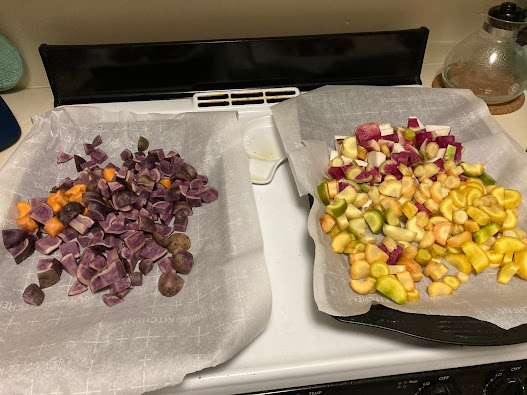
Boom...roasted
By : Vaughan Myers-Jennings
Friday, October 29, 2021
Canning Applesauce
By : Patrice Hall
This is a recipe I have from the website National Center for Home Food Preservation (https://nchfp.uga.edu/), I plan to adjust the recipe for 3 pounds of apples, and I use the boiling water canning method which is best (the pressure canning method is for vegetables and other non-acid foods). I deleted the pressure canning details from this post but if you want to look it up you can go to the website…
Quantity: An average of 21 pounds is needed per canner load of 7 quarts; an average of 13½ pounds is needed per canner load of 9 pints. A bushel weighs 48 pounds and yields 14 to 19 quarts of sauce – an average of 3 pounds per quart.
Quality: Select apples that are sweet, juicy and crisp. For a tart flavor, add 1 to 2 pounds of tart apples to each 3 pounds of sweeter fruit.
Please read Using Pressure Canners and Using Boiling Water Canners before beginning. If this is your first time canning, it is recommended that you read Principles of Home Canning.
Procedure: Wash, peel, and core apples. If desired, slice apples into water containing ascorbic acid to prevent browning. Placed drained slices in an 8- to 10-quart pot. Add ½ cup water. Stirring occasionally to prevent burning, heat quickly until tender (5 to 20 minutes, depending on maturity and variety). Press through a sieve or food mill, or skip the pressing step if you prefer chunk-style sauce. Sauce may be packed without sugar. If desired, add 1/8 cup sugar per quart of sauce. Taste and add more, if preferred. Reheat sauce to boiling. Fill jars with hot sauce, leaving ½-inch headspace. Adjust lids and process.
Processing directions for canning applesauce in a boiling-water canner:
This document was adapted from the "Complete Guide to Home Canning," Agriculture Information Bulletin No. 539, USDA, revised 2015.
Wednesday, September 29, 2021
My Vegetable Soup Recipe
By : Patrice Hall
My regular go-to website for cooking ingredients is Nuts.com, they have a wide selection of spices, nuts and organic foods. I decided to try their organic harmony soup blend so I can use it with my CSA veggies for soups this fall. The carrots and garlic really made this soup golden…
Ingredients
3 cups of Organic Harmony Soup blend (Nuts.com)
7 medium carrots
2 bulbs of garlic
3 Leeks
6 cups of water
2 tablespoons of dried basil
2 tablespoons of black lava salt (or Himalayan sea salt)
1 teaspoon of red pepper flakes
First, take the soup blend and boil it in the water for at least 10 minutes then let it sit for 1 hour. Meanwhile peel the carrots and slice into 2 inch pieces. Clean and cut the leeks into 2 inch pieces. Peel and dice the garlic. Add the carrots, leeks and garlic into the pot with the soup blend, along with the salt, basil and red pepper flakes. Add enough water to the pot to cover the ingredients by 2 inches, then bring to a boil, then bring the pot down to a very low simmer to slow cook the soup for an hour. After it is done, remove from the heat and serve.
Picture from Nuts.com
Monday, September 20, 2021
A Tasty Way To Use Eggplant
By :Vaughan Myers-Jennings
In one of our most recent CSA vegetable hauls, we received eggplant, tomatoes, and garlic (amongst a host of other tasty veggies). While researching potential eggplant dishes, my wife and I came across an amazing Indian dish called Baingan Bhartha. Using all of the aforementioned 3 vegetables, it’s a dish that’s both healthy and delicious.
First, take 3 or 4 eggplants, place on a baking sheet, cover them in oil, poke holes in them using a fork, and broil them until blistered.
While that’s happening, cook down a combination of tomatoes, garlic, ginger, onion, and spices.
When the eggplants are done; peel them, mash them, and mix into your sauce. Yum!
For a more in-depth recipe, use this link: