Norwood CSA Food Co-op

Tuesday, October 25, 2022

Celeriac by Chris Ekstrom

 
Shredded celeriac in a blue and white bowl on the left.  Raw celeriac "root" and celery on the right.  Photo by author.

Celeriac, what is it?  No, it’s not a root, nor is it a stem. It’s a hypocotyl, the area between the root and stem; sometimes referred to as a stem but technically it’s the transitional region between root and stem.  Normally on most plants the hypocotyl is very small but in botany as in life, sometimes there are exceptions, celeriac.  The term hypocotyl is a bit of a misnomer as it literally translates to below cotyledon even though plants lose their cotyledons soon after germinating from a seed…..OK, class is over; let’s eat!

Quick Celery Root Salad with Capers and Lemon by Faith Durand   

 Serves 4
● 1 lemon, juiced
● 1 head celery root, peeled
● Salt and pepper 
● 2 tablespoons walnut oil 
● 1/4 cup good olive oil 
● 2 teaspoons sugar 
● 1 tablespoon red wine vinegar 
● 1/3 cup juicy capers, rinsed 
● Small handful Italian parsley, chopped 

Peel the celery root and shred it. Stop halfway through and sprinkle with a tablespoon of the lemon juice to keep the root from turning brown. Shred* the other half and toss with another tablespoon of lemon juice. Salt and pepper liberally and toss. Whisk the remaining lemon juice with the walnut oil, olive oil, sugar, and vinegar. Taste and adjust. Toss with the celery root, capers, and chopped parsley. Serve.

 *The author recommends using an expensive tool called a Benriner Mandoline Slicer but a cheese grater, food processor or simply chopping and dicing should work.

https://docs.google.com/document/d/1Uu6WP2b6FFaMzxOk6MNHy8EE9IkNsuApMdOdcDdBsws/edit#

***** 

Interested in learning more about the Norwood CSA?  Check out our Info Page: https://norwoodfoodcoop.blogspot.com/2021/10/how-to-join-norwood-csa.html 

Monday, October 17, 2022

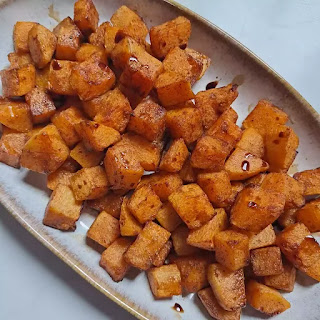
Air Fryer Butternut Squash by Patrice Hall

Golden chunks of seasoned air-fried butternut squash in an oval platter.  Photo by author.
 

I love using an air fryer for times when I want to avoid using the oven. This recipe would take 45 minutes in the oven, but in the air fryer it takes 15 minutes!

You can find this recipe at The Spruce Eats website: https://www.thespruceeats.com/air-fryer-butternut-squash-recipe-5443004

Prep:15 mins
Cook:15 mins
Total:30 mins
Servings:4 servings
Yield:4 cups
 

Nutrition Facts (per serving)
351 Calories
7g Fat
68g Carbs
3g Protein

(Nutrition information is calculated using an ingredient database and should be considered an estimate.)
 

"This is a quick and delicious way to cook butternut squash. The cinnamon brings out the flavor of the squash and the balsamic glaze cuts through any extra sweetness. I had to fry my squash in two batches, so I kept the first batch warm in a very low oven while cooking the second." —Julia Hartbeck


Ingredients
For the Squash
1 1/2 to 2 pounds butternut squash
1 teaspoon ground cinnamon
1/4 teaspoon fine salt, more to taste
1 dash freshly ground black pepper
1 to 2 tablespoons vegetable oil
For the Balsamic Glaze
2 cups balsamic vinegar
1/2 cup packed brown sugar
1 medium cinnamon stick, optional
 

Steps to Make It
Gather the ingredients.
Peel the squash. Scrape out and discard the seeds or roast them as you would pumpkin seeds.
Use a large, sharp chef's knife to cut the squash into 1-inch cubes
In a large bowl, toss the squash cubes with the cinnamon, salt, pepper, and oil.
If your air fryer manual recommends preheating, preheat it to 390 F. Brush the air fryer basket with some oil and add the squash. If you have more than 3 or 4 cups of cubes or your air fryer is small, you may need to cook the squash in 2 batches.
Cook the squash at 390 F for 15 to 20 minutes, stirring the squash or shaking the air fryer basket every 5 to 7 minutes.
Meanwhile, make the balsamic glaze.
Turn on an exhaust fan and open a window if you can. Combine the balsamic vinegar, brown sugar, and cinnamon stick, if using, in a medium saucepan and bring to a boil over medium heat.
Reduce the heat to a simmer and continue to cook until the mixture is reduced and coats the back of a spoon, about 10 minutes. You should have 2/3 to 3/4 cup of glaze. Discard the cinnamon stick.
Transfer the hot butternut squash to a serving dish and drizzle with some of the balsamic glaze to taste.
 

Tips
A y-peeler makes peeling butternut squash fast and easy.
The squash doesn't have to be in a single layer, but avoid filling the air fryer basket more than one-third full, and be sure to toss it every 5 minutes to ensure it cooks and browns evenly.
For the vegetable oil, use one that can stand up to a high temperature, such as avocado oil, peanut oil, or grapeseed oil.
If your balsamic glaze is too thick, thin it with extra balsamic vinegar or water. Rewarm until it is liquid enough to drizzle.
 

Recipe Variations
For savory air fryer butternut squash, replace the cinnamon with 1 1/2 teaspoons of dried rubbed sage. Omit the balsamic glaze and serve the squash with brown butter or sage brown butter, or serve it with freshly grated Parmesan cheese. Adjust the seasonings as needed.
Replace the brown sugar in the glaze with an equal amount of maple syrup or honey.
 

How to Store Leftover Butternut Squash
Refrigerate leftover air fried butternut squash in an airtight container for up to 4 days.
Cooked cubed butternut squash may be frozen as well. Transfer the cooled squash cubes to a labeled zip-close freezer bag and freeze for up to 3 months. Defrost the squash in the refrigerator for a few hours or overnight.To reheat, transfer the leftover butternut squash to the lightly oiled air fryer basket and cook at 390 F for 5 to 7 minutes, until hot all the way through.
 

Can you use cooking oil spray in an air fryer?
Some cooking oil sprays can cause the air fryer basket's nonstick finish to chip. Use a spray or mister with no propellants or use a pastry brush or paper towel to apply the oil. 

*****

Interested in learning more about the Norwood CSA?  Check out our Info Page: https://norwoodfoodcoop.blogspot.com/2021/10/how-to-join-norwood-csa.html 

Monday, October 10, 2022

The Roasted Harvest by Katherine Howitt

The Roasted Harvest


Fall was a welcome respite this year and an excuse to turn the oven back on in response to the very roastable haul. Today we bring our recipe that fits all roastable vegetables but was particularly delicious and attractive this week! Our dressing took its caper inspiration from an Ottolenghi recipe, but as Evan and I continue our experimental approach to all things vegetable, it’s taken on a life of its own in our household. 


This nicest thing about the recipe is how agnostic it is to ingredients - basically any combination of roots, greens, and alliums will do the trick. This one, for example, allowed us to make use of some leftover tomatillos, red onion, and yellow bell peppers from our previous box two weeks earlier (we have a split share). 


We decided to use the koginut as a side dish, rather than include it in the pan, but it would have been just fine in the mix too. 


Ingredients:

Squash side dish: 1 Koginut squash, roasted at 375 for 45 minutes and covered in butter, salt and pepper


Main roast:

Chop, season with spices and olive oil and roast at 400 for 45 minutes:

Tomatillos

Yellow peppers

Sweet Potato

Red Onion

Yellow Onion

1 ½ heads of garlic

3 Carrots

1 Beet


Sauce

Stir  together in a small bowl:

Juice of two lemons

1/4 cup capers

2-3 tablespoons coarse ground mustard


Pour sauce on top once roast is removed from oven. We added some goat cheese from our share on top, which was the perfect addition!


Give thanks to Ottolenghi and enjoy!


Oven roasted vegetables in a glass roasting pan with mustard and caper sauce and goat cheese. Photo by author.


*****

Interested in learning more about the Norwood CSA?  Check out our Info Page: https://norwoodfoodcoop.blogspot.com/2021/10/how-to-join-norwood-csa.html 

Friday, September 23, 2022

Pickling with the Norwood CSA by Elizabeth Wilson

My current ferments entirely with CSA produce and herbs: beets with thyme and radishes with chives, both topped with cabbage to keep under the water. (Photo by author).

I am delighted to share this edited post from the winter CSA about my mild obsession with pickled vegetables.  My family’s dinner table famously includes pickles, apple cider vinegar, sauerkraut, and lacto-fermented CSA vegetables.  Everyone in our family is required to eat one of those daily; guests are encouraged and occasionally inspired to partake, but not required.  

To be more accurate, this post is about lacto-fermentation, but “lacto-fermentation” is not a good hook to get you to keep reading.  “Pickling” is technically with vinegar and heat; a process which does not produce probiotics, which are great for your intestinal health.   Various fermented foods have been a staple of my family’s diet since 2001, when my acupuncturist recommended a tablespoon of sauerkraut for me first thing every morning to improve my gut health. (I blame my poor intestinal health on the fact that I was on low levels of antibiotics for acne for several years as a teenager – antibiotics kill off good bacteria in your gut).   

Lacto-fermentation is a great way to prepare some of those CSA vegetables that are taking up room in your fridge. Fermented veg: 

  • can be stored on the counter 

  • is delicious and great for your intestinal health 

  • preserves the veg for up to a year so you waste less 

I won’t go into all of the benefits of fermented foods, because you can read all about it in the websites below.  But let me just say that you really don’t need any special equipment, I just use unfiltered tap water and I don’t even stress much about sanitizing.  You can do this with nothing special, just the time you need to chop (which can be done by food processor or mandoline), with any jar in your house, or with Fido jars (just open it once a day to release the pressure). 

There are endless recipes to look through, so I narrowed it down for you to the ones I have used with success: 

  • The pickled turnips you get in shawarma – great on any sandwich! 

  • Try these delicious flavorings for fermented beets. 

  • In case that last website felt overwhelming, this one is a more basic one for beets 

  • Raw is delicious, but fermented radishes are less sharp 

  • Anyone else have lots of carrots? 

  • Hot sauce to preserve the hot peppers! 

Happy fermenting!  Feel free to reach out to me at erwilson at gmail for pep talks and encouragement. 

*****

Interested in learning more about the Norwood CSA?  Check out our Info Page: https://norwoodfoodcoop.blogspot.com/2021/10/how-to-join-norwood-csa.html 

Thursday, September 15, 2022

Pasta with Greens and Bacon by Shannon Haas

Small spinach plants growing in soil  Picture by ha11ok (2017). Licensed by Pixaby.

Small spinach plants growing in soil

Picture by ha11ok (2017). Licensed by Pixaby.


Savor those end-of-summer greens for as long as you can! It’s always a delight to see leafy greens in our CSA boxes, especially when the growing season starts to wind down a bit. In September we might find ourselves lucky enough to see lettuce, or maybe even some spinach or other sautee-able greens. 


If you’re looking for some new and creative recipes for greens, I’m excited to share with you a one-pot pasta recipe that takes very little time, is easy on cleanup, and is comforting at all times of year. This recipe is adapted from Budget Bytes - a food blogger I’ve followed for at least a decade. Definitely check out her other simple recipes here for more inspiration: https://www.budgetbytes.com/ 


Ingredients

  • 6 oz. bacon, cut into small pieces (1 inch or less)

  • 1 yellow onion, diced

  • 2 cups chicken broth

  • 1/2 lb. pasta

  • 1/4 lb. fresh spinach or mixture of greens (about 4 cups)

  • 1/3 cup grated Parmesan


Instructions

Step 1: Sauté the bacon in a large skillet until crispy, then remove with a slotted spoon. If needed, pour off some of the fat, leaving 1-2 Tbsp behind. (You can strain the fat and cook another meal with it later)


Step 2: Add the diced onions to the skillet and saute for a few minutes, until soft.


Step 3: Add two cups of chicken broth to the skillet. (I use Better than Boullion mixed with water, if I don’t have homemade broth on hand)


Step 4: Add the pasta to the skillet, cover it, and let it come to a boil over high heat. Once boiling, stir quickly and then turn the heat down to low. Cook for around 10 minutes, or a little longer if there’s still a lot of liquid left (in which case you should uncover the pot to allow it to evaporate). You can check on it and stir it to see how it’s progressing.


Step 5: Add the spinach (or other greens) to the skillet and stir until it has wilted into the pasta. 


Step 6: Turn the heat off and add the crispy bacon and Parmesan cheese. Enjoy immediately!


I haven’t experimented with non-meat substitutes for this dish yet, so if you try it out with an alternative please share in the comments below!

***** 

Interested in learning more about the Norwood CSA?  Check out our Info Page: https://norwoodfoodcoop.blogspot.com/2021/10/how-to-join-norwood-csa.html 

Friday, September 9, 2022

Our Place in the Greater Environmental Struggle by Similejesu Sonubi

Appearances of environmental catastrophe are becoming more frequent, crueler and, at times (for me) it seems insurmountable.  From the water crisis in Jackson, MS, to the current floods in Pakistan, as many of you are aware, the way we live cannot continue. Consumption in all areas of our lives especially in the American context is extremely harmful to the Earth, (especially to those in the Global South.) This was one of the reasons in part, I joined the CSA, to develop different methods of reducing my consumption. 

In many ways I think I've failed, my palate of what my family eats is not used to some of the ingredients we receive, so things go to waste. And I always feel insanely guilty. But, I am challenging myself to be kinder.  And realize this is my first foray into the mindset, thus I will have my starts and stops.  

To return back to some of the environmental crises we are currently facing, it is not as insurmountable as my large corporations and the various news outlets present it as. This is what I choose to believe. To even try to resist, the greater mass consumption that our society is built around is a win. Although it is small; small acts can build up into something greater.  

And what I want to share with anyone who reads this is we have to stay rooted in the present of what an individual is capable of with the resources available to them, but also to be imaginative and work towards a better future. And in that thinking, there will always be paradoxes and moments where you contradict yourself, but the work still has to be done. It's not an or nothing mindset. You fail today and try again tomorrow.

For moments, where it really does get to me, I try to tap into the fictional or nonfictional people who have tried, succeeded, failed, or at least sparked a fire in me and in other movements.  Writers and organizers like Fannie Lou Hammer and Leah Penniman remind me that the environmental struggle did not start, yesterday and there is a shared history to learn upon. Fictional works by Ursula K. Le Guin, Octavia Butler, Hayao Miyazaki, and other Solarpunk authors share my fears and yet somehow imagine something else despite our present.  

Are there ways you feel that you could be more imaginative in how you think of the future?

I would also like to ask if any of you are able, to please look into helping those in Jackson and Pakistan who are facing a struggle too large to ignore.  Thank you.

***** 

Interested in learning more about the Norwood CSA?  Check out our Info Page: https://norwoodfoodcoop.blogspot.com/2021/10/how-to-join-norwood-csa.html